What is DNS? – The Domain Name System Explained!
The Domain Name System, or DNS for short, is often referred to as the phone book of the internet. It allows you to access websites using easy-to-remember names like inwx.de instead of having to enter complex strings of numbers. This is because DNS connects easy-to-read internet addresses with machine-readable numbers and letters called IP addresses.
Every device on the internet, whether a laptop, server, smartwatch, or website, has its own IP address. These addresses consist of either four groups of numbers (IPv4), such as 203.0.113.53, or a longer combination of numbers and letters (IPv6), like 2001:db8:1234:9753::. Since such addresses are difficult to remember and unhandy to enter, the Domain Name System was developed in 1983.
The Domain Name System ensures that websites come with readable names, which are automatically translated into the corresponding IP address. It functions as a distributed, hierarchical database that stores domain-to-IP mappings. Without DNS, you would have to remember the IP address of every website you want to visit. This would make browsing the internet much harder.
The Domain Name System is therefore an essential part of the internet. It forms the foundation for the accessibility of websites, online stores, customer portals, emails, and many other online services.
What is a DNS Server?
DNS servers play a central role in name resolution, which is the process of converting a domain name into its corresponding IP address. There is a globally distributed network of DNS servers, organized into different hierarchies, each responsible for specific zones.
Which Servers Are Involved in the DNS Lookup Process?
Up to four different DNS servers are involved in converting a domain name into an IP address:
The recursive DNS resolver acts as an intermediary between users and other DNS servers. It receives a query from a client (e.g., a browser) and checks if it already knows the requested IP address. If not, it sends additional queries to other servers to find the answer. Essentially, the resolver is the program that manages the name resolution process and retrieves the necessary information from the Domain Name System. It can be compared to a librarian searching for a specific book.
The root server, also known as the root nameserver, is at the highest level of the Domain Name System. It is the first point of contact in the DNS lookup process when the IP address is not stored in the cache. The root server itself does not provide IP addresses but sends back information regarding the correct TLD name server. It functions like a library index, indicating which shelf contains a specific book.
TLD name servers are responsible for specific domain extensions (Top-Level Domains) like .com or .de. These servers are usually managed by the registry that operates the respective TLD (e.g., DENIC for .de or Verisign for .com). When a request is received, the TLD name server directs the query to the authoritative name server of the requested domain. It is comparable to a bookshelf in a library where a specific book is located.
The authoritative name server stores the official IP address of the domain. It gives the final answer to the resolver. It functions like a dictionary found on that bookshelf.
What Are DNS Queries?
A DNS query is a process in which a DNS server asks for the IP address of a domain. The DNS query describes the entire process of translating a domain name into an IP address. This can be a single request or a chain of requests passing through multiple DNS servers until the correct IP address is found.
In contrast, the term DNS request refers only to the first step— the individual request sent by a client to a DNS server.
What Types of DNS Queries Exist?
In a recursive query, the client asks the recursive resolver to find the requested IP address. If the resolver does not have the answer, it asks other DNS servers one by one until it gets the right IP address. If the domain does not exist, it returns an error message.
In an iterative query, the queried server returns the best available answer. If it does not know the requested IP address, it directs the client to another server that might have further information. The client must then send a new query to the next server on its own. This process can be repeated until the correct IP address is found.
A non-recursive query occurs when the queried server already knows the IP address—either because it is stored in its cache or because the server is the authoritative DNS server for the domain. In this case, the response is returned directly, without consulting additional servers.
Each of these query types helps optimize DNS resolution. They make sure that users can access websites quickly and reliably.
How Does the DNS Resolution Process Work?
The process of converting a domain name into an IP address is called DNS resolution. The specific request for a domain's IP—whether from a server or from the cache—is referred to as a DNS lookup.
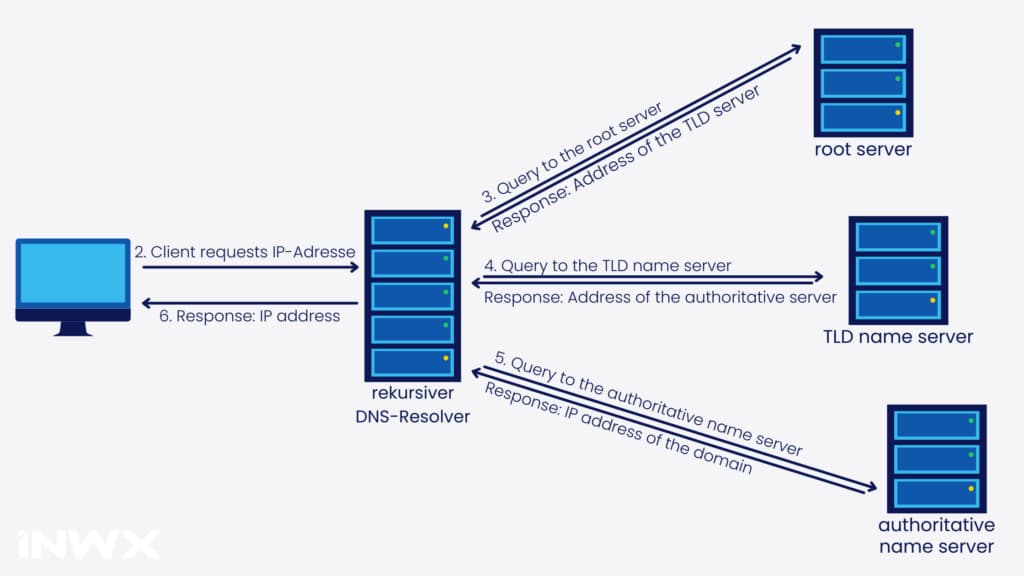
DNS resolution follows these steps, from the initial request by the recursive DNS resolver to the final response from the authoritative name server. The different servers are queried step by step in a hierarchical order until the requested IP address of the domain is found.
- Entering a Domain:A person wants to visit a website and enters a domain into their browser (client). First, the caches of the browser, operating system, and router are checked. If the IP address is not found, a DNS query is initiated.
- Query to the Recursive Resolver:The client asks the recursive resolver for the IP address of the requested domain. The resolver first checks if the IP address is already stored in its cache.
- Query to the Root Server: If the recursive resolver does not know the IP address, it forwards the request to a root server. The root server recognizes the domain extension (e.g., .COM, .DE) and provides the address of the responsible TLD name server.
- Query to the TLD Name Server: The recursive resolver now queries the TLD name server for the IP address. However, the TLD server does not store the IP address itself, but instead sends back to information about the authoritative name server of the requested domain.
- Query to the Authoritative Name Server: The recursive resolver sends a request to the authoritative name server of the domain. This server stores the official IP address and returns it to the recursive resolver.
- Response to the Browser: The recursive resolver retrieves the IP address and returns it to the browser.
- Website Loading: With the retrieved IP address, the browser establishes a connection to the web server and loads the website.
The duration of a DNS resolution depends on several factors. One key factor is caching. If the IP address has already been stored in a cache, the request can be answered much faster. Additionally, the efficiency of the DNS resolver and the performance of the involved servers can impact the speed of the process.
The duration of a resolution depends on several factors. One key factor is caching—if the IP address has already been stored in a cache, the request can be answered much faster. Additionally, the efficiency of the DNS resolver and the performance of the involved servers can impact the speed of the process.
DNS Caching
DNS caching helps websites load faster by storing previously resolved IP addresses. However, problems can arise if a domain's IP address has changed, as the cache may still contain the old address. In such cases, the website might become inaccessible or even load an incorrect page.
To ensure the correct IP address is used, there are several solutions:
- Manually clear the cache: You can clear your browser cache through the browser settings. The DNS cache of your operating system can be cleared via the command line or terminal.
- Restart your router: If the router has cached the wrong IP address, restarting it may help.
- Use a different DNS server: Sometimes, an Internet provider’s DNS server still stores the old IP. Switching to another DNS provider can resolve this issue.
DNS caching is useful but can occasionally cause temporary connectivity issues. If a website is not loading correctly, clearing the cache is a good first step.
Conclusion: Why Is DNS So Important?
The Domain Name System is a fundamental component of the internet. It ensures that you can access websites using easy-to-remember domain names instead of long IP addresses. The DNS lookup process usually runs unnoticed in the background, enabling fast and efficient name resolution. Multiple DNS servers are involved in this process until the correct IP address is found.
Thanks to DNS caching, repeated requests are accelerated, reducing load times and network strain. However, when IP addresses change, temporary issues may arise—clearing the DNS cache often helps in such cases.
Without the Domain Name System, the internet as we know it today would hardly be usable. It connects users to websites, online services, and emails, ensuring that you can quickly and reliably access the content you need.