What is Anycast DNS and what are its benefits?
Every time you visit a website, a process runs in the background that most people never notice: DNS resolution.
The DNS (Domain Name System) translates human-readable domain names like inwx.de into machine-readable IP addresses, the addresses where the corresponding website or service is actually reachable.
This translation is handled by a DNS server. It stores the mapping between domain names and IP addresses and answers requests from browsers whenever someone visits a website. So when someone visits inwx.de, their browser asks a DNS server for the matching IP address in the background, before the website can even load.
You can find a detailed explanation of how a DNS request works and which servers are involved in our article What is DNS?
What is Anycast DNS?
An IP address is usually assigned to exactly one server. Every request to that address always reaches the same, physically fixed server, regardless of where in the world the person making the request is located. This principle is called unicast and is the standard for most home and office networks.
Anycast works differently. Here, the same IP address is used simultaneously by multiple servers at different locations worldwide. Together, these servers form what's known as an Anycast network, sharing the same IP adress.
When a request comes in, internet routing automatically decides which server in this network answers it. Nothing changes for the person making the request. They always see just a single IP address. They have no way of knowing which server actually responded in the background.
When this technique is used for DNS servers, it's called Anycast DNS.
How does Anycast DNS work?
For Anycast to work, multiple servers at different locations worldwide are configured to all use the same Anycast IP address. Internet routing then automatically determines which of these servers answers an incoming DNS query.
When a request reaches a network's Anycast address, it's forwarded to the data center that offers the lowest latency, usually the one closest to whoever made the request.
Benefits of Anycast DNS
Better performance
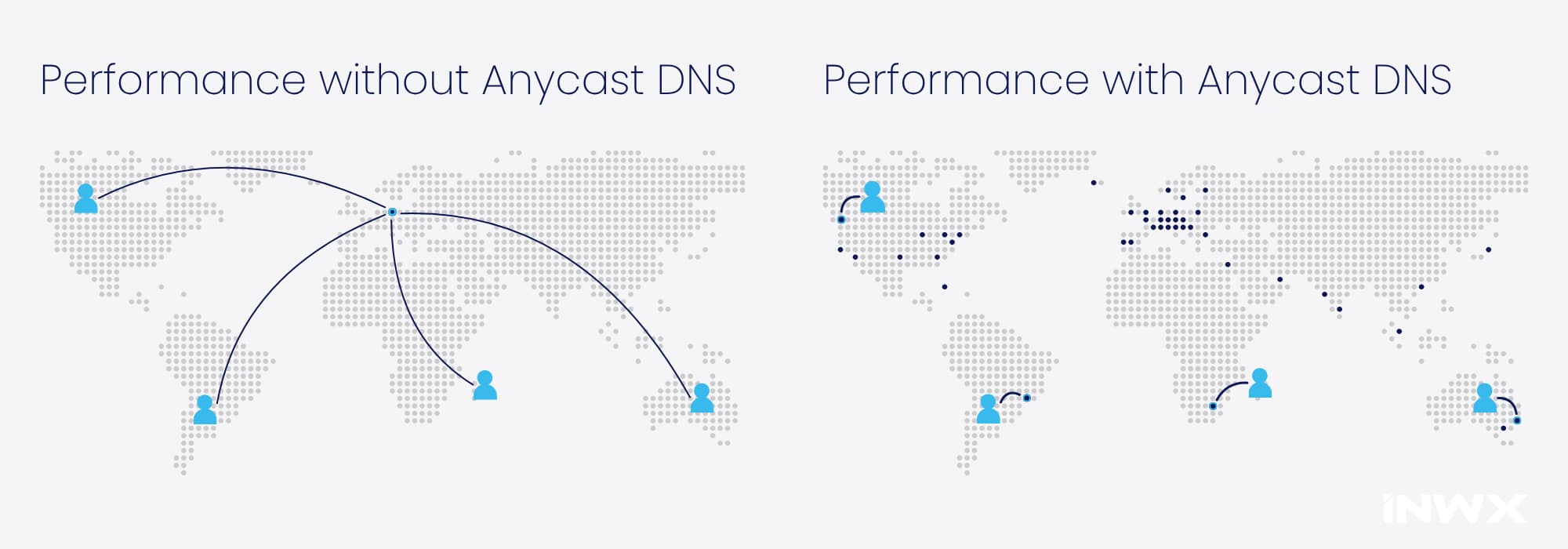
Without Anycast, every DNS query is sent to a single, fixed server, regardless of where the person making the request is located. If someone in Brazil visits a website whose DNS server is based in Berlin, the query has to travel across the Atlantic before the matching IP address can even be found. This costs time and becomes especially noticeable for websites with plenty of international visitors.
With Anycast DNS, the query is automatically routed to the nearest DNS server, based on geographic location and network topology. If a server is available in Brazil, the request is answered there directly, without the detour through Europe. This significantly reduces latency and response times and ensures websites load at a consistently fast speed worldwide.
Redundancy and resilience
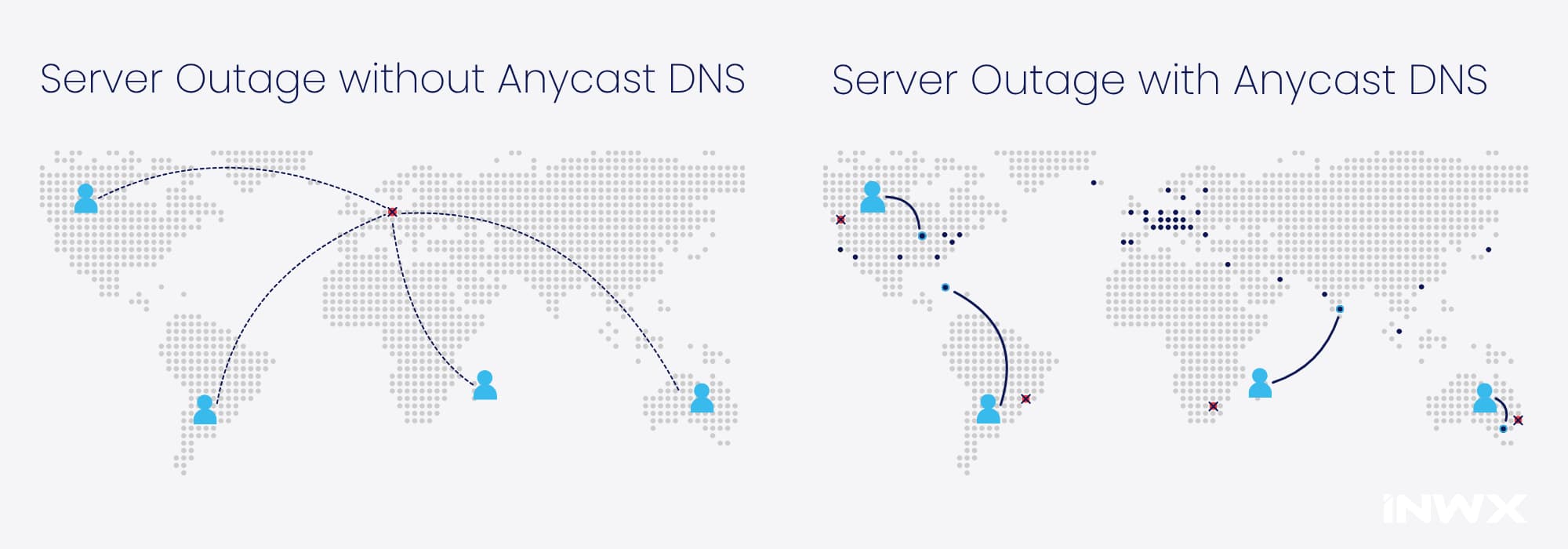
Without Anycast, a website's availability depends on a single DNS server. If that server fails, whether due to a technical fault, overload, or maintenance work, the website becomes unreachable for all visitors, regardless of how stable the rest of the infrastructure is.
With Anycast, exact, synchronized copies of DNS servers exist across multiple locations worldwide. If one of these locations fails, the nearest available server takes over automatically, usually without visitors noticing anything. The website stays reachable at all times, even if parts of the infrastructure go down.
Increased protection against DDoS attacks
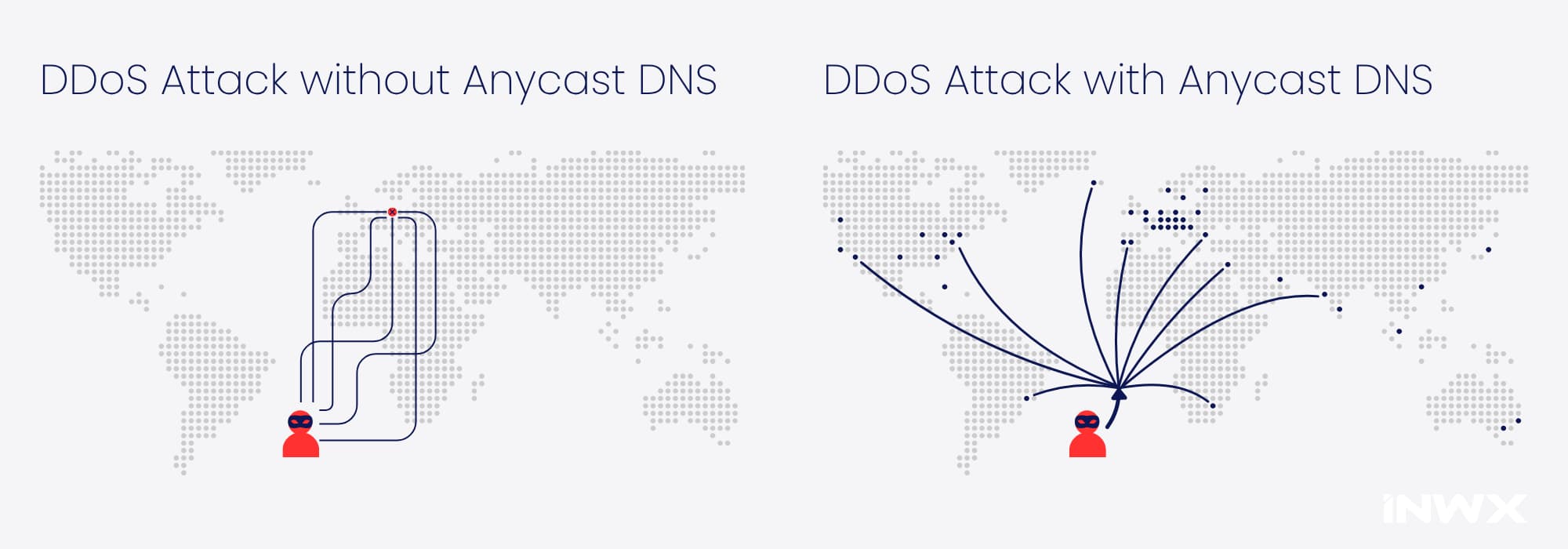
Without Anycast, a single DNS server can be targeted directly. In what's known as a DNS flood, the server is overwhelmed with an enormous volume of requests until it can no longer handle the load, making the associated websites unreachable. This is referred to as a denial-of-service attack: an attack specifically designed to take down a service through overload.
With Anycast, incoming traffic is automatically distributed across many servers at different locations. An attack can no longer target a single server but instead gets spread across the entire network.
This means less load per server, which also lowers the likelihood of a failure. Even if one or more locations were to go down, the remaining servers would keep working normally. This makes the website as a whole more resilient against this kind of attack.
Anycast DNS at INWX
INWX's Anycast DNS infrastructure includes 64 nodes across multiple locations worldwide, spread across three autonomous systems for maximum redundancy.
Anycast DNS service is included automatically for every domain you manage at INWX, no extra configuration required. Want to use our infrastructure for domains you manage with another registrar? We offer nameserver packages for that.
You can find all prices and further information about our DNS services here.