The First Top-Level Domains – Domain History Part 1
Since the introduction of the Domain Name System, thousands of domain extensions have been created. But which were actually the first top-level domains (TLDs)?
In this article, we get to the bottom of the origins of TLDs.
Contrary to popular belief, the .com extension was not actually the first. It was another often overlooked TLD:
The first top-level domain was .arpa, today's infrastructure domain. It served as a temporary solution in 1984 before the first six publicly available TLDs were ready for use in early 1985: .com, .org, .edu, .gov, .mil and .net.
Find out more below.
The history of the first top-level domains
This article is part 1 of our series on the history of the domain. Below is a brief historical overview of the most important developments:
- 1968 – Launch of the ARPANET
- 1971 – Introduction of e-mail
- 1984-85 – The DNS and the first top-level domains are introduced (Part 1)
- 1985 – The first domains are registered (Part 2)
- 1991 – The first website is created (Part 3)
The following graphic provides an overview of the order in which the first TLDs were set up:
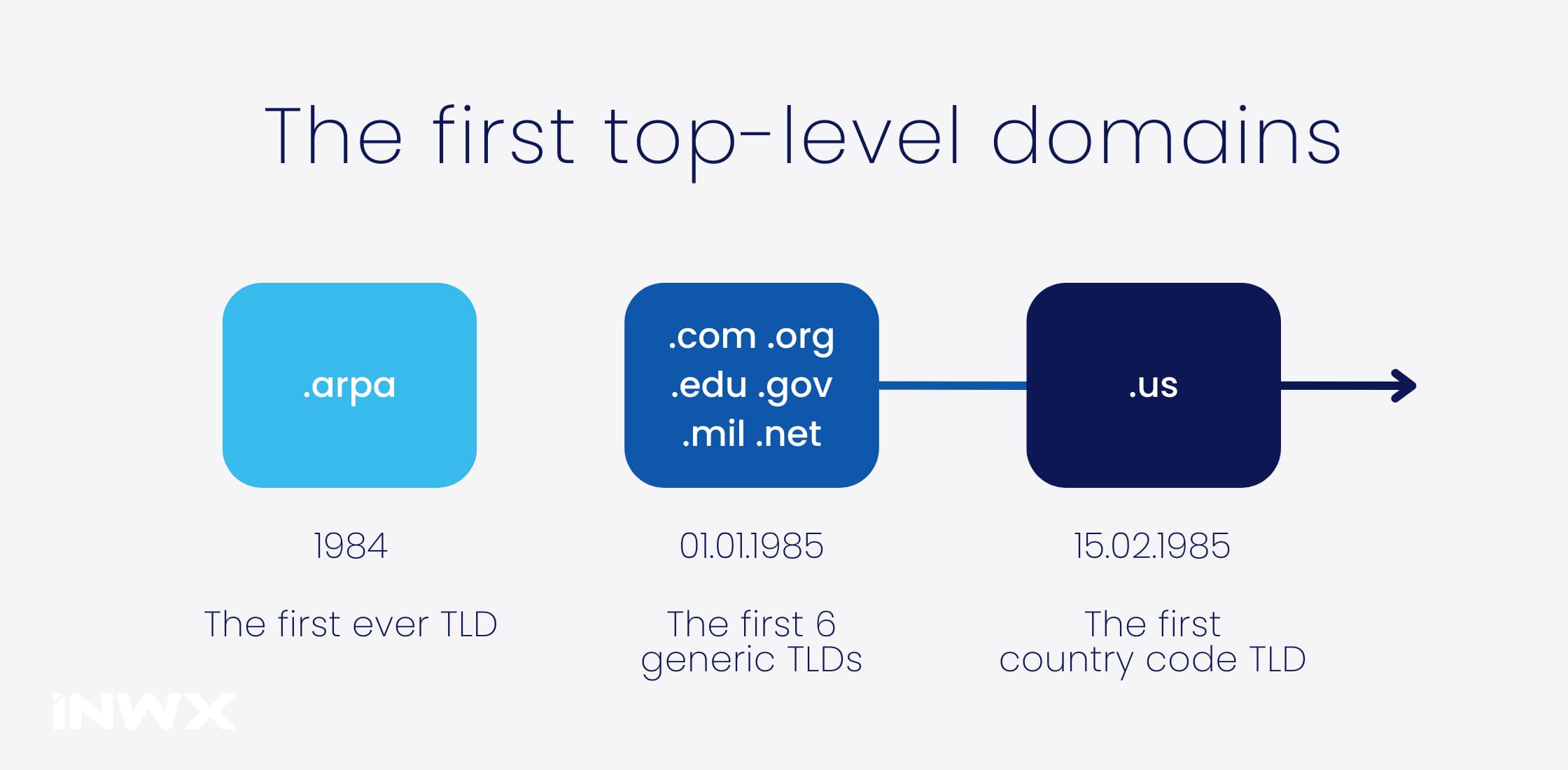
The very first top-level domain in the world
The fact that the .arpa extension is less well-known today is mainly due to the fact that it was never a normal domain extension. It was created as a temporary solution when the forerunner of the Internet (the ARPANET) was to be replaced by the new Domain Name System in 1985.
Even though it cannot be registered publicly, the .arpa domain is still used today. It now has the meaning "Address and Routing Parameter Area" and serves as an infrastructure domain. One use case is reverse DNS lookup, for example. In contrast to the usual DNS lookup, an IP address should be assigned directly to a host. The .arpa subdomain used varies depending on whether IPv4 or IPv6 is used:
- IN-ADDR.ARPA for IPv4
- ip6.ARPA for IPv6
The first generic top-level domains: .com & Co.
The first six publicly registrable TLDs were all published at the same time on 01.01.1985. Three years later, the .int domain was added.
The following seven gTLDs were thus introduced in the 1980s:
01.01.1985:
- .com = commercial (for companies)
- .org = organization (for organizations)
- .edu = education (for educational institutions)
- .gov = government (for government institutions)
- .mil = military (for the military)
- .net = network (for Internet service providers)
03.11.1988:
- .int = international (for international organizations)
These original TLDs were created out of the belief that they would cover every possible thematic area that people would ever want to register.
The first country-specific top-level domains: .us & Co.
The first country-specific top-level domain was .us, which was created just one month after the first gTLDs. This was followed less than six months later by the .uk domain and then the .il domain.
It was already planned which countries would get their own domain extension. The ISO 3166 list was used to make it as easy as possible to assign countries to endings. This contains two-digit country codes for each country as well as many independent regions of the world.
When which country domain was set up depended mainly on the body responsible for administration in the respective country. A registry had to take over all the tasks required for the TLD, such as operating the name servers and managing the namespace – and this took different lengths of time depending on the country. Basically, however, most of the country domains were set up in the 1980s and 1990s.
Below is an overview of the country-specific domain extensions introduced in the 1980s and still in use today:
11985
- 15.02.1985 .us (USA)
- 24.07.1985 .uk (United Kingdom)
- 24.10.1985 .il (Israel)
1986
- 05.03.1986 .au (Australia)
- 25.04.1986 .nl (Netherlands)
- 05.08.1986 .jp (Japan)
- 02.09.1986 .fr (France)
- 04.09.1986 .se (Sweden)
- 29.09.1986 .kr (South Korea)
- 05.11.1986 .de (Germany)
- 17.12.1986 .fi (Finland)
1987
- 19.01.1987 .nz (New Zealand)
- 17.03.1987 .no (Norway)
- 14.05.1987 .ca (Canada)
- 20.05.1987 .ch (Switzerland)
- 08.06.1987 .my (Malaysia)
- 14.07.1987 .dk (Denmark)
- 23.09.1987 .ar (Argentina)
- 18.11.1987 .is (Iceland)
- 15.12.1987 .cl (Chile)
- 23.12.1987 .it (Italy)
1988
- 20.01.1988 .at (Austria)
- 27.01.1988 .ie (Ireland)
- 14.04.1988 .es (Spain)
- 30.06.1988 .pt (Portugal)
- 05.08.1988 .be (Belgium)
- 07.09.1988 .th (Thailand)
- 19.10.1988 .sg (Singapore)
1989
- 19.02.1989 .gr (Greece)
- 18.04.1989 .br (Brazil)
- 08.05.1989 .in (India)
- 31.07.1989 .tw (Taiwan)
- 27.08.1989 .pr (Puerto Rico)
- 13.10.1989 .ni (Nicaragua)
For example, the .de domain was the 10th ccTLD to be introduced.